Warning What does this mean?
Your system is down or running degraded, but this is not an immediate safety danger. Work through the safe steps below.
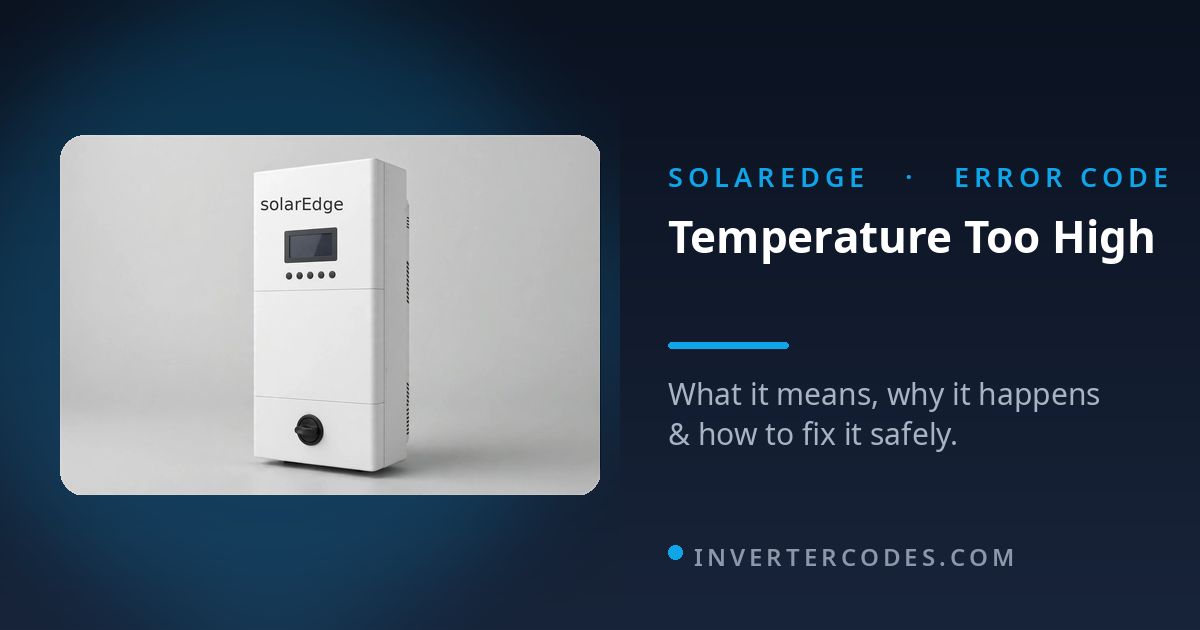
SolarEdge Inverter Temperature Too High — Why It Overheats
Your inverter ran hotter than its safe operating limit and protected itself — it reduces output (derating) and may shut down until it cools. Check that air flows freely around the unit and the heat-sink fins are clean; brief output dips on very hot afternoons are normal.
What should I do first?
Two quick questions — we'll point you to the right starting point.
Is this code still showing on your inverter's display?
Is your system producing power right now?
What this code means
The inverter's internal temperature exceeded its safe operating limit — listed as "Over temperature" in SolarEdge's error table (three-phase codes 8x47 and 8x77–8x79, single-phase 2x11). The unit's response is deliberate and staged: first it derates, deliberately reducing power output to shed heat, and only if the temperature keeps climbing does it shut down entirely until it cools.
That staging matters because it reframes what you are seeing. A dip in output on a 40-degree afternoon is not the inverter misbehaving — it is the protection working exactly as designed, sacrificing some generation to protect the electronics. The problem case is different: shutdowns on merely warm days, or derating that starts early and never really recovers, point to a cooling problem rather than hot weather.
The other thing to check is company this warning keeps. If a Fan Failure warning appears alongside the temperature warning, the story is straightforward — cooling is compromised and the temperature fault is the consequence, not a separate issue. Fix the fan and the temperature problem usually resolves with it.
What is this downtime costing you?
Rough estimate while your system isn't producing. Adjust the numbers to match your setup.
≈ – kWh of lost production per day.
Estimate only — assumes ~80% real-world output vs. nameplate. Actual losses depend on weather, shading, panel direction, and your tariff.
Common causes
- Blocked airflow around the inverter — boxes stored against it, vegetation grown up around it, or an enclosure built too tight. This is the most common cause and the easiest to fix.
- Dust, debris, or spider webs clogging the heat-sink fins, insulating the very surfaces meant to shed heat.
- Installation in direct afternoon sun combined with extreme ambient heat. Some mounting spots simply bake in summer.
- A failed cooling fan reducing heat dissipation — check whether a Fan Failure warning is showing at the same time.
- The unit running at full output through a heatwave. Derating under those conditions is expected behavior, not a fault.
Safe steps to try
Work top to bottom, ticking off each step as you complete it. 0 of 5 done.
Is your inverter still under warranty?
Before paying for a repair, check — your installer may fix this free.
Based on typical standard warranty terms — always confirm with your warranty card or installer paperwork, as terms vary by model, region, and purchase date.
When to call an electrician
Contact your installer if over-temperature shutdowns happen regularly on days that are not extreme, if the unit runs excessively hot despite clear airflow and clean fins, or if the Temperature Too High warning appears together with a Fan Failure warning. The technician will check the internal temperature readings, verify the fans are actually spinning under load, confirm the mounting clearances meet spec, and assess whether the location itself is the problem — in which case a shade hood or relocation may be on the table. Do not improvise your own enclosure or shading; anything that further restricts airflow makes the problem worse. Repeated overheating shortens component life even though each individual shutdown is protective, so a recurring pattern deserves attention rather than patience.
Frequently asked questions
Will overheating damage my SolarEdge inverter?
A single event, no — the derating and shutdown exist specifically to prevent damage. But repeated overheating stresses components and shortens their life, so the underlying airflow or cooling cause still needs fixing.
Can I cool the inverter down with a hose?
Never spray water on electrical equipment. Clear the airflow path around the unit instead, and ask your installer about a proper shade hood if sun exposure is the issue.
Is derating on hot summer days normal?
Yes. Inverters are rated for full power up to a specified temperature, and above that they deliberately reduce output. Check your model's datasheet for its exact temperature ratings.
The temperature warning appeared together with a fan warning — which do I fix?
The fan. A dead fan is very likely the cause of the overheating, and the temperature fault is the consequence. Get the fan replaced and the temperature issue usually resolves with it.
Need a professional?
This fault may need professional diagnosis. Contact a qualified solar electrician in your area.
Sources: meaning and troubleshooting verified against the manufacturer's documentation — Troubleshooting SolarEdge Systems, Addendum (Europe & APAC), MAN-01-00333-1.1 — Temperature Too High row ('Over temperature'; three-phase CPU v3.19xx: 8x47, 8x77-79; troubleshooting: 'Verify proper inverter clearances. Make sure the heat-sink fins are clean and unobstructed.').